Monthly Archives: December 2016

Daniel’s Seventy Weeks #4

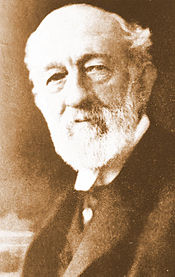
Sir Robert Anderson (1841-1918) is remembered by many Bible students today for his contribution to the interpretation of the book of Daniel. However, in the 19th century he was also known as a high ranking official at Scotland Yard, the second Assistant Commissioner of the London Metropolitan Police.

Sir Robert Anderson (1841-1918) is remembered by many Bible students today for his contribution to the interpretation of the book of Daniel. However, in the 19th century he was also known as a high ranking official at Scotland Yard, the second Assistant Commissioner of the London Metropolitan Police.

Daniel’s “Seventy Weeks” prophecy, as found in Daniel 9:24-27 is often regarded as the key text for understanding the prophecy perspective held by advocates of dispensationalism, as made popular by books and movies associated with Tim Lahaye’s Left Behind. Yet as we noted in a previous post in this series, this passage from Daniel plays actually a limited and somewhat obscure role in the New Testament, especially when compared to passages such as Psalm 110, which is quoted or alluded to some thirty times in the New Testament, as we sought to exposit earlier a few years ago on Veracity.

As I have been digging into the interpretation of Daniel 9:24-27, for nearly two years, inspired by the “astronomical” work of my friend, Ken Petzinger, I have been learning that the controversies surrounding these four verses of the Bible are fascinatingly complex. In this post, I want to lay aside some of the Bible interpretation issues aside, and focus instead on some questions of history:

So, where did the “dispensationalist” approach to Daniel 9:24-27 come from? Why is it that the prophecy of the “Seventy Weeks” has become so important in the minds of so many Christians, over the past hundred or so years?
Continue reading


People Disagreed With Jesus About the Bible Too

I am in the middle of posting a five-part blog series on the interpretation of Daniel 9:24-27, the famous “Seventy Weeks” prophecy, one of the most controversial Old Testament prophecies predicting the coming of the Messiah. Some scholars call it the “Dismal Swamp” of Biblical interpretation. After digging into this for about two years, I can believe it really is a swamp.

The passage is really fascinating and amazing, but the pervasive interpretive pluralism among Christians, as to what the prophecy means, can be overwhelming. There have been times where I have been tempted to throw my hands up in the air and give up. Thankfully, I ran into the following re-post from Derek Rishmawy’s blog that serves as a healthy antidote to following such a temptation.

Derek Rishmawy is also a co-host of the MereFidelity podcast, that I sometimes listen to, that combines thoughtful theological reflection and conversation, with engagement in contemporary cultural issues impacting the English speaking world. These guys are smart, and just listening to the British accents of some of the other co-hosts makes you feel a little bit smarter yourself, too. If you need some intellectual stimulus that you are not getting elsewhere, you should check out the podcast sometime at the MereOrthodoxy website.

Derek Rishmawy's avatarReformedish

Jesus talking“Yeah, but there are so many interpretations of that text, so many denominations claiming Scripture for their own, you can’t really say there’s a wrong way of reading it.”

If you’ve been in a Bible study or spent more than about 10 minutes surfing pop theology writings, you have probably run across a claim of this sort. The idea is that with so many different readings of Scripture, it’s either arrogant or hopeless to think we can come to a determinate, or correct understanding of it. In other words, the mere fact of interpretive disagreement ought to put us off from claiming anything very strong for our interpretations of Scripture.

This sort can take a couple of different forms.

First, someone can go full-blown, radical skeptic and just say that the text has no inherent, determinate meanings, only uses. Or maybe that it’s a springboard for our own thoughts about…

View original post 880 more words


Classic-Thinking: Thomas Oden

Thomas C. Oden wrote A Change of Heart, a theological memoir of how as a thinker he made the journey from Protestant Liberal to a truly evangelical and broadly ecumenical man of faith.

Thomas C. Oden wrote A Change of Heart, a theological memoir of how as a thinker he made the journey from a Protestant Liberal to a truly evangelical and broadly ecumenical man of faith.

I loved heresy…But the Holy Spirit found me,” so said Methodist theologian Thomas C. Oden (1931-2016), who died December 8, 2016.

Thomas Oden had grown up in the world of mainline Methodism, in the mid-20th century. He fully imbibed the liberal theology of his day, immersing himself in the writings of Rudolph Bultmann and Paul Tillich. He was a leading thinker and theological spokesperson for a radical redefinition of Christianity that swept through American mainline churches in the 1950s to 1960s. He had admired the Vietnamese Ho Chi Min as an agrarian patriot. But then he realized that he had been wrong.

In an interview a few years ago with Southern Baptist leader, Al Mohler, Oden confessed that his enthusiasm for Marx was misguided. “I loved the fantasies and I loved the revolutionary illusions. I truly loved them… I was one of those who was way out on the far left edge of accommodating to modernity. And I don’t know how but the Holy Spirit found me.

A caring Jewish friend had encouraged Oden to read the patristic writers, those fathers of the early church who wrote extensively within the first few centuries of the Christian movement. Up to that point, Oden “was able to confess the Apostle’s Creed, but only with deep ambiguity. But I stumbled over ‘he arose from the dead.’ I had to demythologize it and could say it only symbolically. I could not inwardly confess the resurrection as a factual historical event.”

When Oden finally realized that the bodily resurrection of Jesus was something that he must believe and eventually did believe, in order to be a true Christian, it reoriented his life. He spent the second half of his life repudiating the hubris behind the very liberalism that nurtured him, and sought to build a case for a consensual model of Christian belief, looking to those early, classic church fathers for guidance. His change of heart was now to serve the church, and not to seek after the latest theological fad of academia.

Oden never broke away from his modest, classically-informed Wesleyan theological leanings. He sought for reconciliation in the predestination and free-will debates that still divides Calvinists and Arminians. He eschewed debates over the age of the earth, charismatic gifts, the “proper” view of the millennium and the “End Times,” and other intramural discussions, in order to focus on the common vision of faith embodied in the early creeds of the church, like the Nicene Creed.

As having read Thomas Oden’s Classic Christianity: A Systematic Theology, as the basic theology textbook in seminary, I can say that Oden was not as strong as an apologist or a textual Bible scholar, but these were not his gifts. His gift was in drawing together the widest range of the greatest teachers in the historical Christian tradition, to give us a “big picture,” consensus view of what it means to believe as a faithful follower of Jesus: Classic Christianity at its finest!!

Michael J. Kruger, at the Canon Fodder blog, offers some lessons learned from Thomas Oden.


Daniel’s Seventy Weeks #3

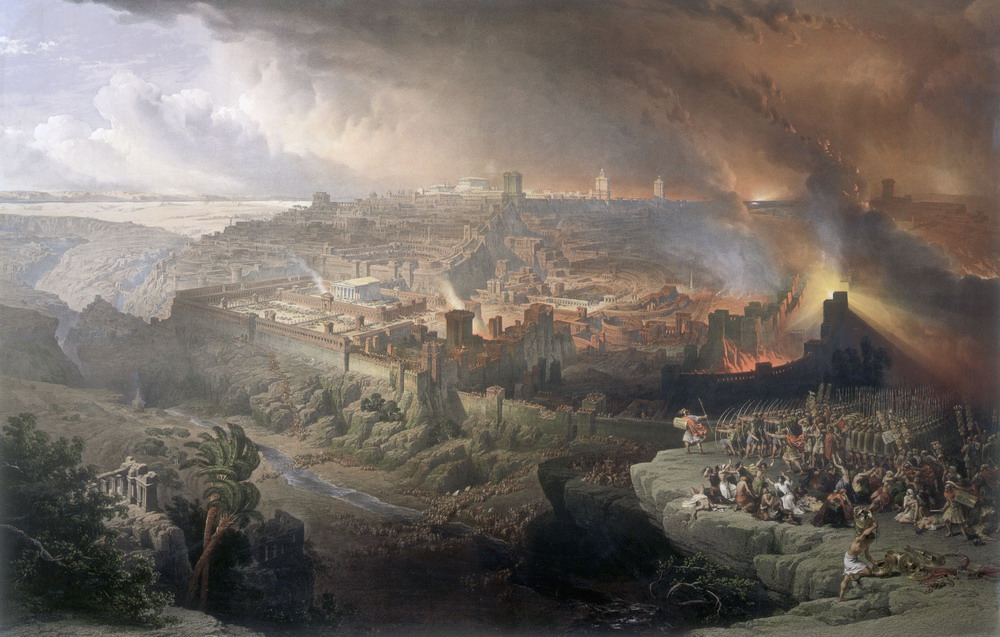
The destruction of Jerusalem by the Romans in 70AD -- a painting by David Roberts (1796-1849).

The Roman army under Titus destroyed Jerusalem and its Temple, by the year 70 AD. Does this catastrophic event in the first century offer any insight into understanding the “Seventy Weeks” prophecy found in Daniel 9:24-27?  
(a painting by David Roberts, 1796-1849).

Up to this point in this series ( post #1, post #2), we have been exploring the dispensationalist approach to the “Seventy Weeks” of Daniel 9:24-27. Let us jump into the text again, first:

“Seventy weeks are decreed about your people and your holy city, to finish the transgression, to put an end to sin, and to atone for iniquity, to bring in everlasting righteousness, to seal both vision and prophet, and to anoint a most holy place. Know therefore and understand that from the going out of the word to restore and build Jerusalem to the coming of an anointed one, a prince, there shall be seven weeks. Then for sixty-two weeks it shall be built again with squares and moat, but in a troubled time. And after the sixty-two weeks, an anointed one shall be cut off and shall have nothing. And the people of the prince who is to come shall destroy the city and the sanctuary. Its end shall come with a flood, and to the end there shall be war. Desolations are decreed. And he shall make a strong covenant with many for one week, and for half of the week he shall put an end to sacrifice and offering. And on the wing of abominations shall come one who makes desolate, until the decreed end is poured out on the desolator” (Daniel 9:24-27 ESV).

So, is the dispensationalist reading of this passage the best way to understand the text?

Let us explore some of the issues in this blog post. Different Bible interpreters over the years have looked at Daniel 9 in very different ways. When you examine each approach, you learn that there are some ambiguities in the text that force the interpreter to make some assumptions as to how a particular ambiguity in the text might be resolved.

So, what are these ambiguities? Have you ever heard of Hank Hanegraaff, known in radio-land as the “Bible Answer Man?” Continue reading


Single-Mindedness: Helen Roseveare

Helen Roseveare (1925-2016) was one of the great missionary spokespersons of the 20th century. Roseveare served as a medical missionary in Zaire, surviving a violent civil war there, where she was brutally raped in 1964. In her moment of utter darkness, she prayed to God, and she sensed the Lord telling her, “You asked Me, when you were first converted, for the privilege of being a missionary. This is it. Don’t you want it? . . . These are not your sufferings. They’re Mine. All I ask of you is the loan of your body.”

I had the privilege of hearing Helen Roseveare speak at the Urbana ’87 missionary conference. Her single-minded devotion to the Lord sustained her in extended periods of loneliness, in her near 20-years ministering in Zaire.

She never married.

Justin Taylor, at the Gospel Coalition, posted a remembrance of her life. She died today.