Monthly Archives: November 2024

Religion of the Apostles, by Stephen De Young, a Multi-Part Review (#4 Concluding Topics: the Lost Tribes, Law, Sacraments, Elders)

Here we wrap up this review of Stephen De Young’s The Religion of the Apostles: Orthodox Christianity in the First Century, with an assortment a various topics, and some critical reflection.
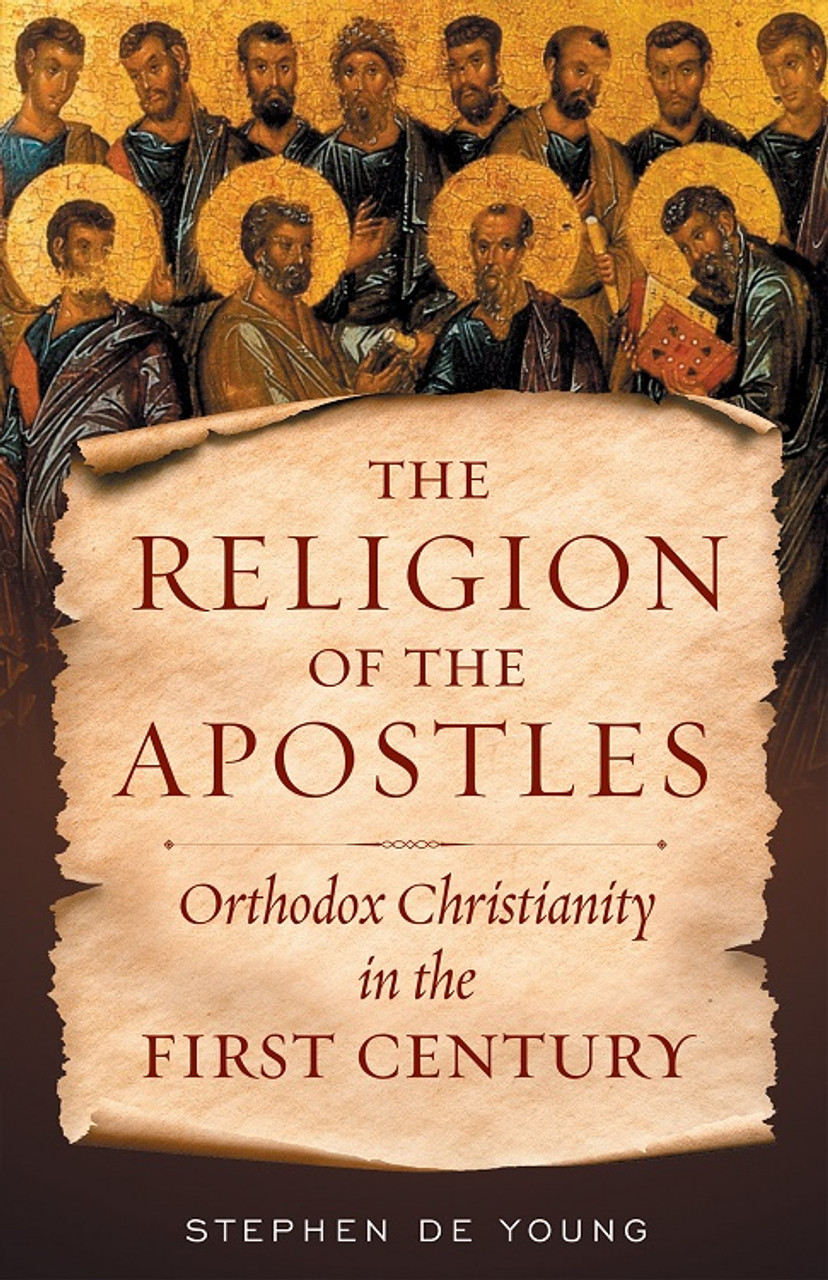
The Religion of the Apostles, by Stephen De Young, shows how the beliefs and practices of the early church connect with the world of Second Temple Judaism, the historical context for Jesus of Nazareth and the New Testament.


The most important parts of The Religion of the Apostles cover the Trinity, the Divine Council, and the Atonement. But after the chapter on the atonement we have a grab bag of topics that I will just toss into this last post of this book review, looking an Eastern Orthodox perspective on the earliest Christians, by Father Stephen De Young.

The Ten Lost Tribes …. and the Gentiles

The next chapter examines what took place to transition the Old Testament people of God, Israel, to that of the New Testament church, made up of both Jew and Gentile alike. De Young makes much of the mystery of what happened to the Ten Lost Tribes of Israel, who were conquered and deported by the Assyrians, about 150 years before the destruction of Jerusalem and the Southern Kingdom, by the Babylonians. The message of the prophets was to promise that not only would the Jews of the Southern Kingdom be restored to the land following the Babylonian exile, but that the Ten Lost Tribes associated with the Northern Kingdom would be restored as well.

De Young argues that the process of cultural assimilation of the Ten Lost Tribes meant that “the northern tribes could be restored only from among the Gentiles” (De Young, p. 230). While some might consider this as controversial, we see this in the Jewish “apocryphal” tradition preserved in Eastern Orthodoxy and Roman Catholicism: “The Hasmonean Kingdom, after the Maccabean revolt, formed a treaty with the Spartans in which they are said to be descendants of Abraham (1Mc 12:21)” (De Young, p. 230).

How else could these Spartans be considering descendants of Abraham if they were not somehow connected to the Ten Lost Tribes? While there is legitimate criticism that a kind of “replacement theology” unfortunately played a negative role in the early church after the destruction of Jerusalem in 70 C.E., De Young’s argument shows that the Scriptural treatment of the Ten Lost Tribes reveals just how “nonsensical” such a replacement theology really is, going back to a Second Temple Jewish context (De Young, p. 237).

This opens up a way of reading Paul’s enigmatic statement in Romans 11:26, “all Israel will be saved.” This may not sound like a big deal to most readers of the Bible, but it serves as a clue as to what Paul was really getting at in the Book of Romans, particularly Romans 9-11,  by demonstrated that Paul was appealing to a known tradition within Second Temple Judaism, about the relationship between the Ten Lost Tribes and the Gentiles, as opposed to just making something up out of his own head.

Was Paul inventing his own weird interpretation of the prophet Hosea in Romans 9:22-26, as some critics of the Bible claim, like Rabbi Tovia Singer? Perhaps not!! The original context for Hosea 2:23 is a reference to Israelites conquered by the Assyrians, but Paul sees this as a reference to the Gentiles. Stephen De Young’s analysis offers a defense of Paul’s reading grounded in the thought world of Second Temple Judaism.

The Law of Moses and the Gentiles

The chapter on “The Law of God” argues that Christ indeed came to fulfill the Law, but that more recent developments in theology, particularly since the Protestant Reformation, have divided the Law of Moses into three categories: the civil, ceremonial, and moral commandments. It is generally thought that Christ fulfilled both the civil and ceremonial aspects of the Law, and yet the moral aspect is still binding on the Christian. However, De Young argues that this three-fold classification is not found in Scripture, as there are no divisions in the text regarding the meaning of the Law (De Young, p. 257ff).

The whole Law of Moses is fulfilled in Christ. The best way of understanding the fulfillment of the entire Law of Moses is through the Sabbath. “The first day of the week, then, becomes the Lord’s Day.” God’s people “now participate in the Resurrection of Christ in anticipation of their own resurrection and eternal life in the world to come” (De Young, p. 264).

The Council of Jerusalem, found in Acts 15, helps us to comprehend the relevance of the Law of Moses in the life of the New Testament church. An appeal to portions of Leviticus were made at the council as the means by which Gentiles can be brought into the community formerly made up of Israel alone, by instructing Gentile believers to follow four commands: to abstain from food dedicated to idols, sexual immorality, from meat with blood still in it, and from blood. It is in this sense that the Law of Moses still applies to all Christians.

Therefore, all four commands of these commands are binding among Christians today. Refusing to eat food offered to idols is still to be followed, as well as the prohibition against sexual immorality, which has been challenged in recent years by certain Christian groups. The author does mention that the eating of blood, and the eating of meat with blood still in it is connected to the context of pagan worship in Leviticus 17:10-14 (De Young, pp. 264-265).

But he does not go into detail on the specifics of how this should be applied today, a significant drawback in this particular chapter. Nevertheless, De Young insists that Eastern Orthodoxy consistently seeks to apply these four commands even today, as well as holding to more ancient worship practices more closely associated with the “ceremonial law,” whereas both Protestant and Roman Catholic Christians have shifted away to varying degrees from such practices, which were standard in the first century church (De Young, pp. 264-275).

As an evangelical Protestant, I am not wholly persuaded that the three-fold distinction of the Mosaic Law, as articulated by John Calvin in his The Institutes of the Christian Religion lacks the Scriptural basis that De Young says it does. But he does make a good argument that the Acts 15:19-20 ruling for accepting believing Gentiles among the people of God is still in force. However, I am inclined to think that the restrictions against eating food from animals still with blood in them, and against eating strangled animals generally, are really admonitions to stay away from practices associated with idolatry. In most Western contexts today, as opposed to theologically-oriented customs in the Ancient Near East, the eating of animal blood has little to do with idolatry.

In the Ancient Near East, animals that were strangled still had blood in them, and since blood has been understood as the symbol of life, and the surrounding pagan cultures around the Israelites used such blood in their worship practices, the Old Testament instructs the people to stay away from such idolatrous worship practices. But while the use of blood is generally not common in idolatrous worship practices today, at least in the Western secular world, there are plenty of idolatrous worship practices that Christians in a secular world context should still stay away from.

Baptism Fulfills Circumcision

De Young closely associates the practice of baptism with being a fulfillment of circumcision. In this way, just as infant Jewish boys were circumcised, so in Christ’s church both infant boys and girls are to be baptized. This is not that far from a covenant theology approach dating back to the Protestant Reformation, which affirms infant baptism, without getting bogged down in certain aspects of baptismal regeneration, which most Protestants vigorously reject; that is, the idea that the very act of baptism in and of itself in some sense saves the person.

“…baptism, like circumcision before it, was never an individual act or pledge. Rather, it has always been, from the very beginning, a communal act of family, clan, tribe, and nation; the new nation that is called by Christ’s name, the Church” (De Young, p. 284).

The emphasis on baptism as a communal act, and not an individual one, is a pretty foreign idea to Western Christians. Baptism is about drawing the believer into the life of the covenant community, just as circumcision identified the Old Testament Jew as a member of national Israel. I wish Stephen De Young would have explained this communal sense of baptism some more.

Linking the Presbyteriate of the Church to the Elders of Israel: The Sacramentality of Eldership

This is a bit of a rabbit trail, but it is an important one. De Young defends the origins of the clerical orders of the church by connecting them back to practices in ancient Israel and Second Temple Judaism. The dominant scholarly narrative has been that the development of church order did not arise until the late first century at the earliest, or even into the second century. This scheme of church order, as articulated primarily in the Pastoral Epistles (1 Timothy, 2 Timothy and Titus) sought to domesticate Paul’s message to make it more palatable to the social standards of Greco-Roman culture:

“This narrative has been put forward with such force that it has been used to argue for a later dating of any book of the New Testament that mentions the Church or her orders. In the case of the Pastoral Epistles, it is used to argue that they must be minimally sub-Pauline, reflecting later developments after the end of the apostle’s life” (De Young, p. 288).

In other words, this common scholarly narrative suggests that some admirer of Paul forged letters (the Pastoral Epistles) to make them sound Pauline, but in doing so, changed Paul’s message to make his teaching appear to inline with the cultural standards of the day.

In contrast, according to De Young, Paul really did write the Pastoral Epistles, and he did so with a genuine reason in mind going back to the Old Testament. The great apostles of the early church functioned much like the elders selected by Moses, the seventy, who assisted him in governing the Israelite people in the wilderness (Numbers 11:16-17). Paul then describes what this apostolic ministry looked like in 1 Corinthians 4.

Once the original apostles begin dying and are removed from the scene, the “episkopos,”  or “overseers” or “bishops,” take upon themselves the continuation of the unfulfilled apostolic task.  The “episkopos,” sometimes translated as “herdsman” in the Greek Old Testament, are often interchangeably associated with the “presbyters,” the elders of the church. These overseers/elders are charged to maintain continuity with the original apostolic ministry. In addition to the episcopate and presbyterate (made up of qualified men), an additional level of ministry leadership was added and fleshed out by the second century, to include both a male and female diaconate (De Young, pp.290-291).

It is interesting that De Young ties the New Testament concept of elders to the elders of ancient Israel, and not to the Levitical priesthood. For many Protestant Christians today, it is still somewhat confusing when the concept of “elder” (“presbyter,” in Greek) is often interchanged with the notion of “priest.” But when one realizes that the term “priest” is simply the shortened version of “presbyter,” this should be less problematic to those Protestants who are wary of connecting “elder” and “priest” together. In other words, a “priest” in the early church did not strictly correspond to a Jewish Temple “priest,” if it did at all.

We know this from the New Testament as the Book of Hebrews (Hebrews 7:13-17) mentions that Jesus is a priest, not in the order of Aaron, but rather in the order of Melchizedek, a point that De Young brings out (De Young, p. 286). De Young does not connect the dots here, but this would suggest that the concept of New Testament “elder” is tied back to this earlier notion of priesthood, and not the priesthood of the Second Temple. The Levitical priesthood, associated with the ritual of the temple, which no longer physically exists, has now been superseded by the final sacrificial ministry of Christ. But the concept of priesthood more generally, as with the priesthood of Melchizedek, still has relevance.

There is, of course, the “priesthood of all believers” which suggests that Christ is the sole mediator between believers and God. Nevertheless, there is still a kind of continuity that the New Testament concept of presbyter (elder) has with the Old Testament, demonstrating that the office of elder by the early Christians was not simply some invention without precedent. Elders are not “above” other believers, as though they are members of a superior class, but they do serve a specific sacramental function in the life of the local church.

Many Protestants tend to miss this, ignoring the sacramental function of New Testament “elder,” however ill-defined this might be, for fear that this might be confused with the more medieval sacerdotal practice of Roman Catholicism. Granted, there is no explicit teaching found in the New Testament which links the Old and New Testament concepts of “elder” and “sacrament” together, but De Young makes a strong case that the early church did understand it this way. When “elder” is understood without a sacramental sense standing behind it, then the notion of “elder” in Protestant circles tends to get relegated to the sense of the person or persons “in charge,” or a purely administrative “board of directors,” which does not carry the proper sense and function of the New Testament word.

Presbyters (Elders)… And “Women in Ministry” in the Early Church

Furthermore, while De Young also does not mention this, his reasoning would further explain why Jesus only selected men to be his twelve apostles, despite the fact that women figured prominently in Jesus’ earthly ministry, several of whom effectively bankrolled the itinerant movements of the wandering band of Jesus’ disciples, and who were the first witnesses to the Resurrection.

Some have suggested that Jesus only selected men to be among “the Twelve” in order to be sensitive to the cultural norms of the day. But this argument is highly problematic. For example, this type of egalitarian apologetic does not seem consistent with the Jesus who made mincemeat of other cultural norms of the day, by publicly rebuking Pharisees, challenging normative interpretations of the Sabbath laws, throwing out the money changers in the Temple, and even challenging the very Temple system itself. Why would Jesus be so forceful in challenging those cultural norms of the day while being so timid with the question of women being possible candidates among the Twelve?

Instead, it is apparent from reading The Religion of the Apostles that the Paul’s establishment of the office of elder (presbytery) is meant to continue the apostolic ministry that he, and other apostles, original represented, to ensure that the Christian movement would stay on the right track, after that original group of apostles were dying off and leaving the scene. In the pastoral letters in particular, Paul is greatly concerned about false teachers corrupting his own teaching that he was trying to pass on. This is why Paul charged the elders of the church in Ephesus to properly stay in alignment with his teachings and to protect the people (the sheep) from being led astray from false teachings, as Paul was quite clear that he would not return to them (Acts 20:17-38).

It follows then, that it would be consistent that Paul would restrict the office of elder/overseer in 1 Timothy to be only for qualified men, while still affirming the leadership roles of women in other areas, like deacon. If Paul believes that the office of elder/overseer was meant to carry on the role of the original apostles, once the apostles were dead and gone from the earthly scene, as was evidently the case in the early church, then it would make sense for Paul to only designate qualified men to serve as elders/overseers, consistent with how Jesus designated those who were among the Twelve.

De Young’s treatment of the development of the presbytery (office of elders) resolves a number of lingering questions in my mind. For if Paul indeed did follow Jesus’ model for selecting the twelve male disciples to be the original group of “elders,” and copy Jesus in establishing the presbytery to continue the apostolic ministry of that first generation of Jesus’ inner circle, it does raise the question as to why both Jesus and Paul had only men in mind for this, considering that women were also highly valued as disciples and in exercising leadership functions themselves.

Yet De Young demonstrates that it was not the Aaronic line and its association with the Jewish temple priesthood that Jesus or Paul had in mind to emulate. Rather, it was the position of Jewish elders grounded in the twelve patriarch fathers of Jacob’s sons that served as the model. Jesus’ selection of twelve Jewish men as apostles was therefore not simply a one-time, one-off fulfillment of some Old Testament prophecy, but rather, it set a pattern for the early church moving forward beyond the lifetimes of those original twelve.

We might also add that the priesthood in the order of Melchizedek is relevant. De Young associates the celebration of the Lord’s Supper as being an imitation of the priesthood of Melchizedek (De Young, p. 287). The office of elder can be thought of as a sacramental reminder that the local church is a kind of expression of the twelve tribes of Israel, extending back through history, preserving a long line of family lineage. I am only guessing, but it would have been more helpful if Stephen De Young could have “tied off the bow” with the discussion, as this seemed to be where he was aiming.

All of what has been noted above concerning the office of elder is hotly contested within Protestant evangelical circles today. The debate among complementarian and egalitarian Christians continues to divide Protestant evangelicals, as to the roles of women and men in church leadership. Complementarians insist that Paul’s directive in 1 Timothy 2 & 3 has a universally binding character, while disagreeing amongst themselves as to how the distinction between men and women in church office is to be applied. The main feature common among most complementarians has been that only qualified men are to serve as elders in a local church, whereas there are no gendered restrictions anywhere else in the New Testament church. In other words, women may lead in the church in various ways, but that the office of elder has been reserved for qualified men.

Alternatively, egalitarians, at least the most exegetically sensitive ones, say that Paul’s teaching regarding men and women in 1 Timothy suggests a different context, focusing on the particular issue of female false teachers in Ephesus specifically. Many such Protestant egalitarians reject any sacramental function served by local church elders, preferring a more secular-type role for elders in terms of Christian leadership. Yet this egalitarian perspective is inconsistent with a more general, universalizing design for church offices, a view classically held by Eastern Orthodox thinkers, including Stephen De Young.

Is the New Testament Canon of Scripture Fixed? In Eastern Orthodoxy, the Answer is Yes

The charge of misogyny against the early church in terms of women in local church leadership is a highly sensitive matter in today’s culture. Much of the controversy stems back to how early church history is interpreted. Yet as I have suggested before, if it could be successfully argued that the pastoral letters of Paul, including 1 Timothy, were indeed outright forgeries, then this would most simply settle the matter in favor of the egalitarian concerns, without the complex exegetical gymnastics often associated with those egalitarians who try to defend Pauline authorship.

But there is no indication that such a revision of the canon would ever be accepted in Eastern Orthodoxy. Nor does there seem to be any significant felt need to attempt such a revision. I doubt that such a re-evaluation of the canon of the New Testament will take place in other branches of Christianity, like Roman Catholicism or Protestantism (except for perhaps progressive Christian Protestants). While many modern scholars have their doubts about the authenticity of 1 Timothy, Eastern Orthodox tradition solidly affirms 1 Timothy as genuinely Pauline, and started to do so fairly early within the history of the early church. As indicated by De Young, the whole array of Eastern Orthodox church offices depends upon the entirety of the tradition drawn from the pastoral letters, primarily including 1 Timothy.

Yet while Stephen De Young sees a certain kind of continuity between the Paul of 1 Timothy and his Second Temple Jewish forebears regarding relations between men and women in the worship assembly, there is also a discontinuity. Some, though not all, Second Temple Jewish texts do suggest a kind of misogyny. For example, the pseudepigraphical Apocalypse of Moses, which scholars date as a Jewish writing from the time period of Jesus, reads a completely different twist into the Genesis narrative. According to the Apocalypse of Moses, Eve and the serpent had a sexual relationship with each other, at the instigation of the devil. A plot was then conceived to cast Adam out of the Garden of Eden. In contradiction to Genesis, Adam was not even present when Eve and the serpent had their discussion about the forbidden fruit, thereby deceiving the innocent Adam in the process.

Nevertheless, the early church rejected this particular narrative, in favor of a different tradition within Second Temple Judaism. In other words, it is better to speak of “Judaisms” in the plural as opposed to “Judaism” in the singular when when we think of the Second Temple Jewish tradition.

The early church followed certain strands of Judaism, or certain “Judaisms,” while rejecting others. Some of these rejected “Judaisms” helps us to explain how certain Christian heresies became popular in the early church. For example, the Gospel of Thomas, probably dated to the second century, was deemed not worthy of inclusion in the New Testament canon, in part because of its teaching that women must somehow become men in order to find salvation, a view which historic orthodox Christianity, in both the East and the West, flatly rejected. If there is ever clear evidence of misogyny in the early centuries of the Christian movement, it was surely in the kind of Gnostic heresy reflected in the Gospel of Thomas.

Paul’s push towards having a female diaconate, most exemplified by the example of Phoebe in the Book of Romans, shows clear evidence of being accepted within early Christian communities. The common assumption that women never had leadership positions within the early church is without foundation, as the ministry of the diaconate served a vital role in the early centuries of the Christian church. Nevertheless, the practice of having a female diaconate faded out in later years of Eastern Orthodoxy. It suggests to me that given the evidence at hand, Scriptural and historical, that Eastern Orthodoxy might be open towards re-establishing a female diaconate…. or at least they should.

Critical Evaluation of The Religion of the Apostles: MORE FOOTNOTES PLEASE!!

One other observation to note in Religion of the Apostles is the lengthy discussion regarding the peculiar reference in 1 Corinthians 15 about the “baptism for the dead” in the chapter about redeemed humanity’s role within the Divine Council (De Young, pp. 161ff). But this must be saved to a future blog post.

While The Religion of the Apostles is very thorough and helpful, there are some drawbacks with the book. The most troubling is the unevenness regarding De Young’s footnotes. Sometimes De Young pinpoints the ancient Second Temple sources he uses to make his case. But too many times De Young fails to adequately cite his sources,  leaving the reader with incomplete footnotes. To me this explains why some other reviewers of The Religion of the Apostles have concluded that De Young is over promising what he actually delivers in the book.

Perhaps De Young opted to try to keep his footnotes to a minimum in order to make his book more accessible to his intended audience. I can imagine that if De Young would have fleshed out his footnotes it might have doubled the size of the book, and he did not want to do that.  If this is the case, then perhaps De Young should consider a second edition of The Religion of the Apostles with more extensive footnotes, enabling readers to better see for  themselves what sources he is using.

Some claims are even made by De Young that lack any source citation whatsoever. “The four rivers that flow from Eden are the Tigris, the Euphrates, the Nile, and the Danube” (p. 174).  Those last two rivers are typically found in English translations of Genesis 2:10-14 as the Pishon and the Gihon, which are not the same as the Nile and the Danube, at least to my knowledge. So, where does De Young get the Nile and Danube from? De Young is assuming certain details as common knowledge among his readers, which is not the case.

Eastern Orthodox Apologetic Stumbling Blocks

The apologetic purpose of Stephen De Young might serve as a stumbling block for those who might benefit the most from his book. There is plenty in The Religion of the Apostles which will ruffle the feathers of those outside of the Eastern Orthodox tradition. Evangelical egalitarians will bristle against the idea that the concept of a male-only presbyteriate goes back to Jewish sources grounded in the Old Testament, and perhaps even Jesus’ selection of twelve men as the original apostles, as opposed to some adoption of Greco-Roman misogyny which supposedly crept into the early church, as some evangelical egalitarians imagine.

Evangelical Protestants of all stripes will find offense at the suggestion that Protestants have erred by leaving a deep hole in the history of God’s revelation, by ignoring various books of intertestamental literature (known as the “Apocyrpha” in Protestant circles), which the Eastern Orthodox consider to be Scripture (De Young, p. 14). Roman Catholics will be chagrined at charges of unwarranted accretions in the Catholic Mass, and other areas of Roman Catholic doctrine (De Young, p. 285), for which the Eastern Orthodox see as innovations away from the original religion of the apostles.

As might be expected from an Eastern Orthodox theologian, De Young cites evidence from the Old Testament which affirms the veneration of Mary, as the “Theotokos,” though not certainly not as dogmatic as what you can find from some Roman Catholic writers. De Young cites 1 Kings 2:19 to show that Solomon had a second throne placed on his right hand for his mother, Bathsheba, as queen, establishing the precedence for Marian devotion which arose during the early church period (De Young, p. 152). Protestants probably will not find such evidence to be convincing. Along with a variety of other Eastern Orthodox distinctives, there will be Roman Catholic and Protestant readers who will not be persuaded by particular arguments made here and there.

The Religion of the Apostles of the First Century: Tied to Certain Second Temple Judaic Traditions

However, the greatest value of The Religion of the Apostles is not in its apologetic for Eastern Orthodoxy, but rather in its tying the earliest beliefs and practices of the Christian church back to beliefs and practices associated within Second Temple Judaism. Stephen De Young may or may not present arguments which will ultimately sway readers to embrace Eastern Orthodoxy. For example, I remain currently unpersuaded by Stephen De Young’s apologetic, but I appreciate the challenge he brings to some of the deficiencies of evangelical Protestantism.  Nevertheless, De Young challenges the evolutionary notion that much of the early church beliefs and practices were pure innovations disconnected from the Second Temple Judaism that preceded it. This insight is worth the price of the book alone.

As one can probably tell from the length of this review, over multiple blog posts, The Religion of the Apostles is a remarkably substantial book coming in at about 320 pages. But while the topics covered are many, the argumentation is concise, dealing with fundamental matters of doctrine, and answering many, many questions about the Bible along the way.

Much of what Stephen De Young writes about, particularly as that which pertains to theological strands within Second Temple Judaism and the Divine Council, will be new to some readers. But De Young’s book should sufficiently demonstrate that the contribution of contemporary scholarship which seeks to retrieve significant elements within Second Temple Jewish thought is far from being “new,” as some uninformed critics have wrongly claimed. As a reminder, it is important to repeat that Second Temple Jewish thought was wide-ranging, and that the teachings of the New Testament fall in line with certain particular elements of Second Temple Jewish thought, and not the whole range of Second Temple era ideas. In summary, the thematic content addressed in The Religion of the Apostles goes back to the early church era, and even beyond that, back to particular strands of Judaism in Jesus’ day, which is also the main point made by the late Protestant Old Testament scholar, Michael Heiser, in his book The Unseen Realm.

In many ways, The Religion of the Apostles is the Eastern Orthodox version of Michael Heiser’s work found in The Unseen Realm. (Father Stephen De Young is also pleasant to listen to, as his narrates himself the whole of the Audible audiobook version of The Religion of the Apostles).

Stephen De Young’s treatment of the development of the doctrine of the Trinity stands out as a particularly helpful apologetic for Nicene orthodoxy.  The same could also be said regarding the doctrine of the atonement, offering a bridge where common ground can be held for Western and Eastern Christians alike.

I can engage with at least one friendly critic briefly at the end of this review here. Kaspars Ozolins, a research associate at the Tyndale House in Cambridge, England, and a thankfully informed, sympathetic, and competent reviewer of efforts to educate the church about Divine Council theology, still says that an emphasis on the Divine Council “is sometimes imbalanced and suffers from a deliberate attempt to downplay the church’s historical engagement with Scripture.” Yet readers of The Religion of the Apostles will find a cogent argument which does the exact opposite, emphasizing the church’s historical engagement with Scripture to make its case for continuity between historic Christian orthodoxy and Second Temple Judaism. Evangelicals would do well to take such Divine Council theology more seriously as an apologetic answer to those critical scholars, going back to the German higher critical movement of the 19th century, to say that early Christianity, and even the New Testament itself, was primarily a product of syncretism with Hellenistic philosophy and theology.

Those who are skeptical about the theology of the Divine Council would do well to read The Religion of the Apostles, to show just how much various early church fathers accepted certain Second Temple Jewish interpretive traditions into their reading of the New Testament.  I just wish that Stephen De Young would have beefed up his footnotes and interacted more with critics. Hopefully, such criticism will get back to De Young, and  spur him on in writing an expanded future second edition of this important work. But if footnotes do not matter to you, you will still benefit from Stephen De Young’s expert combination of scholarship grounded in Second Temple Judaism and the teachings of the early church.

Religion of the Apostles, by Stephen De Young, a Multi-Part Review (#3 The Atonement)

When we say that Jesus died for sins, what do we mean by that exactly?

Stephen De Young in his The Religion of the Apostles: Orthodox Christianity in the First Century dives into this topic, which has at times caused some friction between evangelical Protestant and Eastern Orthodox Christians. But perhaps both sides have more in common than many realize. In the interest of Christian apologetics, both Protestant and Eastern Orthodox Christians together have an answer to give to those secular and progressive critics who say that Christians invented their doctrine of atonement, based on the assertion that atonement had nothing to do with the message that Jesus taught.


The Religion of the Apostles, by Stephen De Young, shows how the beliefs and practices of the early church connect with the world of Second Temple Judaism, the historical context for Jesus of Nazareth and the New Testament.


Forgiveness Without Atonement?

Bart Ehrman, a religion professor at University of North Carolina at Chapel Hill, perhaps the most influential living skeptic of historically orthodox Christianity, makes an argument which will probably shock the average Christian. For Ehrman, Jesus preached a message of forgiveness, whereas Christianity as an organized faith teaches a message of atonement, which are two completely different things.

For Ehrman, forgiveness is simply “letting go” the fault of another person, without any price or payment associated with it. The only condition for extending forgiveness is repentance, the act of turning from a sinful act, with the intention never to commit the sinful act again.

Atonement, on the other hand, is about a payment for debt incurred by sin, in order to cancel the debt. Unless a payment has been made, the debt can not be canceled.

In Ehrman’s mind, Jesus was all about forgiveness, whereas his followers, particular those who followed the Apostle Paul, changed Jesus teaching in order to stress an atonement for sin instead. For example, in Mark 2:1-12 when Jesus heals the paralytic lowered through a roof in Capernaum, Jesus forgave the man’s sins. There was no mention of atonement. There was no mention of needing to go to the Temple to make a sacrifice. No sacrifice was necessary. God, through Jesus, simply forgave the man.

Ehrman goes on saying that in the Gospel of Luke, and even in the Book of Acts, there is no doctrine of atonement. In Acts following Jesus’ death and resurrection, Jesus’ death is frequently mentioned, but it is never connected with atonement. As Ehrman argues, for Luke, “Jesus’ death makes you realize how you have sinned against God and you turn to God and beg his forgiveness, and he forgives you.  No one pays your debt; God simply forgives it.”

It was not until we get to the Apostle Paul, and perhaps others in the early Jesus movement, that we get the sense of atonement as being the full basis for why forgiveness is possible from a Christian perspective.  Repeatedly, Paul makes the case that Jesus’ death actually paid some sort of debt. In Romans 5:8, “God shows his love for us in that while we were still sinners, Christ died for us.” In Ephesians 5:2, “Christ loved us and gave himself up for us, a fragrant offering and sacrifice to God.”  In Galatians 3:13, “Christ redeemed us from the curse of the law by becoming a curse for us.”

Ehrman adds, however, that in Mark’s Gospel, supposedly someone probably put on the lips of Jesus an idea of atonement, decades after Jesus’ earthly ministry ended. In Mark 10:45, “For even the Son of Man came not to be served but to serve, and to give his life as a ransom for many.”

If Bart Ehrman is correct, then it would appear that a certain group of Christians, which eventually became the “orthodox” party of the early church, essentially invented a theory of atonement to explain the  relationship between Jesus’ death with the forgiveness of sin. The implication should be obvious. From Ehrman’s vantage point, the message of Jesus is ethically superior than the message of Paul: Crudely put, Jesus offers forgiveness for free, while Paul’s brand of forgiveness comes at the cost of a life, human or some other animal.

However, there are some very good reasons for saying that Bart Ehrman is quite wrong about his assessment that Jesus’ message of forgiveness was in stark contrast with the later, supposedly “invented” teaching of the church, associated with Paul.

One of the great benefits Stephen De Young’s The Religion of the Apostles: Orthodox Christianity in the First Century is that it offers a convincing apologetic for why a theology of atonement is fully integrated into the teachings of Jesus, as seen through the lens of Second Temple Jewish thinking. While Religion of the Apostles does not directly address Bart Ehrman’s critique of Pauline Christianity, as being morally inferior to the teachings of Jesus, Stephen De Young lays down a foundation for why the forgiveness of sins is intricately connected with the concept of atonement. Far from being an invention of the early church, the New Testament doctrine of atonement is drawn from centuries of Jewish meditation on the Old Testament Scriptures.

“The Scriptures and the Fathers understand Christ’s atoning death as the revelation of His divine glory. Atonement as it took place in the Old Covenant, as described in the Hebrew Scriptures, represents a partial and preliminary revelation of the glory of Christ, which comes to its fullness in His death on the Cross” (DeYoung, p. 192)

In other words, Christianity did not invent atonement and decades later bolt it somehow onto the teachings of Jesus concerning forgiveness. Rather, the life, death, and resurrection all stand within the steady stream of Jewish thought during the period when the Second Temple was still standing in Jerusalem. The New Testament shows us how Jesus fulfills and thereby transcends certain older ways of thinking about atonement, something not limited to the world of Judaism in the first century and its Temple in Jerusalem. The sacrifice of Jesus on the cross enables the message of God’s forgiveness of sins to be a universal message, empowering a universal message of forgiveness with respect to God (vertically) and with one’s neighbor (horizontally).

For Stephen De Young, there have been a number of theories about atonement discussed in Christian theology which are either only partially supported by Scripture, or some even not found in Scripture at all.  In this third blog post in this book review series, we now take a closer look into De Young’s defense of an Old Testament-grounded theology of atonement which the early church adopted through divine revelation. De Young’s full treatment in his apologetic has some minor problems, as I see it, but in the long run, his understanding of the early church view of atonement offers an adequate answer to Bart Ehrman’s skepticism.

Forgiveness Is Not As Easy As Some May Think

Here is an anecdote to show why Bart Ehrman’s viewpoint is unsatisfactory: About 13 years ago, my wife took our Italian greyhound out for a walk in the neighborhood, as she normally did. We live in a rural area, where few dog owners in our neighborhood keep their dogs on a lease. Suddenly, one of our neighbor’s dogs, a rather large one, jumped out onto the road where my wife was strolling along with our rather small, 10-pound greyhound. This big dog mauled our little greyhound, grabbing him by the throat, thrashing him around. The big dog finally let go, but our Italian greyhound was permanently injured by the incident.

The combination of the physical and the emotional trauma led to a severe decline and eventually an early death of our little dog less than two years later.

We were able to forgive our neighbors for allowing their dog to go free without a leash, and then attack our dog, but it was difficult. We spent hours and hours trying to nurse our dog back to health, not to mention the costly visits to the vet, only to watch our dog slowly lose his zest for life due to the trauma.

Our neighbors received our forgiveness, but it was not easy for them to fully accept it. Their big dog had himself experienced some abuse earlier in his life, so it was not altogether unexpected for him to lash out on our Italian greyhound. They had tried other ways help their big dog to become healthier and better behaved, but that proved to be very difficult. I am not sure what exactly happened with that dog, but the dog did not remain very long in our neighborhood after that.

No amount of money for vet visits could have ever fully helped out our little Italian greyhound come back to full health. I am convinced that our neighbors continued to feel guilt about the incident for years to come, as they were reminded about it every time they saw my wife or myself trying to walk our dog down the street again, much slower than before the attack.

We paid a price to extend our forgiveness. Our neighbors paid a price in terms of the guilt they experienced.

Chances are, as you are reading this, you can think of examples in your own life where it was difficult to forgive someone else for some wrong committed against you. You might even think of examples when someone tried to forgive you of something you did, and you still ended up feeling guilty.

Forgiveness is costly. It is not as easy as some may think.

The idea that forgiveness can be extended or obtained without paying some sort of price, as Bart Ehrman suggests, is unrealistic.

Atonement in the Early Church

In The Religion of the Apostles, Stephen De Young rejects the idea of different “models” to describe Christ’s atonement, which he sees is a movement away from “describing” what Christ accomplished on the cross towards “explaining” how and why Christ accomplished what he did (De Young, p. 191). To his point, we can get so bogged down with which model best explains the atonement that we miss the big picture. That the atonement works is what ultimately matters, more so than trying to tease out how it works.

Nevertheless, De Young’s rejection of various models, like that of penal substitutionary atonement, seems to this reviewer to be a bit of special pleading. Everyone has a theory of how atonement works, whether one realizes it or not. But happily this reviewer agrees with De Young that a Christian need not pick one model and thereby reject other models. There is a richness in understanding how Christ’s atonement for sin works, drawing from multiple models, each one potentially offering a different dimension of thought not fully addressed by other models. Stephen De Young is sensitive to this, and rightly so.

For example, later in the book, De Young notes that the Jewish Passover, which is connected to Christ’s own sacrifice had no concept of substitution associated with the ritual:

“There is no indication that the lamb is being killed instead of a firstborn human losing his life. This is clear for several reasons when the text is read carefully. No attention is paid by the ritual text to the killing of the lamb. This means that its death is incidental to the ritual, not part of it. Rather, the focus is on how the lamb is to be cooked and eaten (Ex. 12:3–11)” (De Young, p. 234).

But this need not indicate that Christ’s sacrifice lacked any sense of substitution, as there are other elements in Jewish atonement tradition which are substitutionary in character. In Eastern Orthodoxy, there is a general sentiment that penal substitutionary atonement is to be rejected.  Well, at least the penal concept is rejected, while retaining the substitutionary atonement part. Historically, the penal substitutionary model has been the standard evangelical Protestant view of Christ’s atonement. However, in the modern period, a number of Protestants have grown squeamish about penal substitution today as well.

But much of this sentiment against the standard Protestant view of atonement relies on a caricature of penal substitution. This caricature wrongly assumes that the loving Son of God is killed on the cross in order the appease the anger of God the Father against human wrongdoing. It carries the sense of a kind, loving Son who has to somehow assuage the uncontrolled wrath of an angry Father, who is royally ticked off at humanity.

This caricature was driven home to me when I heard it preached at a youth evangelistic event years ago. The speaker pictured God the Father as being so angered by sin that he acts as a judge and executioner who must impose punishment on the sinner. The Father has a gun and must shoot the sinner, standing in as a representative for “us;” that is, all of humanity, in order to satiate his anger. However, at the last minute, the kind and sacrificial Son steps into view, the Father turns the gun towards the Son, and takes the bullet on our behalf.

Looking back, I know that the speaker had meant well, and no illustration of the meaning of the cross is perfect. But this type of illustration is pretty terrible.

To the contrary, Jesus as the Son of God is just as angry with human sin as the Father is. Likewise, the Father is just as loving towards humanity as the Son of God is. The key to understanding the doctrine of atonement, and its relationship to the forgiveness of sins, is that Jesus’ death on the cross is an act of self-sacrifice. Because of God’s self-sacrificial love for us, not only are we forgiven of our sins, we are also enabled and empowered as humans to self-sacrificially extend forgiveness towards others who have hurt us.

De Young’s efforts at “describing” Christ’s atonement show that a broad array of Scriptural themes can be brought to bear on the meaning of Christ’s atonement, including elements that make up the doctrine of penal substitution; that is, the teaching that Jesus died in our place in order to pay the penalty for our sins. Admittedly, some evangelical Protestants wrongly focus exclusively on penal substitution, so in this sense, Stephen De Young’s closer look at how Second Temple Judaism influenced the early church offers a very helpful corrective to the typical Protestant caricature of the doctrine of atonement.

God’s Wrath and a Better Understanding of Propitiation

De Young acknowledges the role the wrath of God plays in purifying the sinner of sin, as in a purifying fire, and he helpfully points out the Old Testament language of God being “slow to anger,” which is rooted in a Hebrew idiom of being “long of nose” (De Young, p. 194). De Young accepts the concept of propitiation, which is often seen as the heart of the doctrine of penal substitutionary atonement. Perhaps as an Eastern Orthodox priest, Stephen De Young is not far off from an historic, standard Protestant view of atonement? But helpfully, he notes that propitiation has a simple meaning:

“it means to render someone propitious, or favorably disposed. At its most basic level, it refers to an offering that is pleasing to God” (De Young, p. 203).

The pagan form of propitiation does not map well onto the biblical form of propitiation. For in pagan sacrificial ritual, the killing of an animal is required to satiate the wrath of the gods. But in the Bible, “attempting to import this concept into the sacrificial system established in the Torah is simply impossible. Much of the sacrificial system of the Law does not even involve the killing of an animal, even though the offerings it calls for are always food” (De Young, p. 203). Instead, it is the pleasing aroma that is offered up to God that matters. The actual killing of the animal itself is not tied to the propitiation towards Yahweh.

‘Some sort of punishment or suffering on the part of the sacrificial animal was no part of the ritual. Even in the case of whole burnt offerings—which stipulated that the entire animal be burned and thereby given to Yahweh—it is not sacrificed alive but is killed first, unceremonially……. The more common language used in the Scriptures for God’s appreciation for His portion of sacrificial meals is that these sacrifices are a pleasing aroma (as in Gen. 8:21; Lev. 1:9, 13; 2:2; 23:18). This same language is applied to the sacrifice of Christ in the New Testament (in Eph. 5:2 and the Father’s statement that in Christ He is “well pleased”)’ (De Young, p. 203).

This more mature view of propitiation goes against the common misunderstanding about propitiation, pedaled by those such as Bart Ehrman. Ehrman’s false view wrongly links biblical propitiation with some “barbaric” requirement of an animal death meant to satiate the supposed bloodthirsty demands of an angry god. This is the worst caricature of all regarding the doctrine of atonement in Christianity. As the late Michael Heiser has said, “It is not that God is thirsty for blood.”

De Young also links God’s justice less with retributive justice, whereby criminals are merely punished for their crimes, and more with distributive justice, which is more linked to civil law. Someone has been wronged, and therefore an attempt is made to try to rectify the wrong so that the injured party can be made whole (De Young, p. 196).

While the following analogy does not work well for vegetarians, the analogy that I can think of to best begin to explain this is the experience of eating a good steak on a grill. What makes someone happy, or pleased, or “propitious” about a good steak meal is not the fact that a cow had to be killed to supply the meat. What makes for a pleasing or “propitious” steak meal is the aroma of a freshly cooked steak on the grill, and the eventual eating of that steak. This is reasonably close to the idea that the pleasant aroma of a cooked sacrificial meat is what is “propitious” in God’s perspective, not the killing of the animal to supply the meat. This is the basic difference between a biblical view of propitiation versus a pagan view of propitiation which celebrates the killing of an animal.

Propitiation, rightly understood therefore, is not about God’s supposed inner need to kill someone or some animal, or have someone or some animal killed to make God happy. Israel’s pagan neighbors had that understanding but not Israel herself. Rather, as Joel Edmund Anderson puts it in his review of The Religion of the Apostles, propitiation celebrates “the restoration of relationship and a demonstration of His justice and righteousness.”

Other Dimensions of Atonement Theology

De Young highlights Colossians 2:14 as an expression of atonement theology: ““He canceled the handwriting in the decrees against us, which were opposed to us. And He has taken it from our midst, by nailing it to the Cross.” Sin is here associated with the concept of debt, in that Christ’s death canceled the debt of sin (De Young, pp. 206ff). De Young goes on to say that this made perfect sense in Paul’s first century context, as the slavery system of the time was employed as a means of paying off debt.

“Slavery in the ancient world was not primarily an instrument of racial or ethnic oppression. Rather, it was primarily an economic institution. With no concept of bankruptcy in the modern sense, the means by which a debt that could not be paid would be settled was indentured servitude. A person would work off the debt by becoming a slave” (De Young, p. 207)

This understanding of slavery is helpful in that it is a stark contrast with the type of slavery practiced in the American antebellum South, which was specifically racial in character. While not answering every question about what the Bible has to say about slavery, De Young frames the discussion in a way that can assist us to get past many of the polemical critiques against Christianity today.

Furthermore, the atoning work of Christ is universal in character, impacting every human being (1 John 2:2; De Young, p. 215). Yet this universal character is often misunderstood (De Young, p. 209). As a result, De Young’s rejects the doctrine of universalism, most notably defended by a fellow Eastern Orthodox scholar, David Bentley Hart (See Veracity analysis of universalism espoused by David Bentley Hart). For De Young, universalism as those like David Bentley Hart presents it, is a Christian heresy that is fully dismissed by Eastern Orthodox tradition, contra David Bentley Hart. (For a substantial interaction with David Bentley Hart’s universalism thesis, one should consult this episode of the Lord of Spirits podcast for a full critique. For a modest, cautious defense of David Bentley Hart with respect to Stephen De Young’s critique, see this essay by Jesse Hake).

Interestingly, De Young shows that certain strands of Eastern Orthodoxy have preserved certain Second Temple Jewish understandings of atonement, that are typically unknown to Protestants: “Texts such as the Apocalypse of Abraham, which has been preserved in Slavonic by the Orthodox Church, describe an ultimate eschatological Day of Atonement” (De Young, p. 218).

Another Second Temple Jewish tradition linked to atonement theology, associated with the figure of “Azazel,” can be found in the Book of Enoch. In the Enoch literature, Azazel is identified as the leader of angels which rebel from Yahweh, those members of the divine council that sought to subvert God’s ultimate rule (DeYoung, p. 125).

1 Enoch 10:8 says, “The whole earth has been corrupted through the works taught by Azazel; to him credit all sin” (compare 1 John 3:8; 5:19). (DeYoung, p. 125).

One other particular observation that De Young makes is very intriguing: Several translations of Leviticus 16:8 link Azazel with the scapegoat, sent out into the wilderness as part of the Jewish atonement rituals. “And Aaron shall cast lots over the two goats, one lot for the Lord and the other lot for Azazel” (Lev. 16:8 ESV, De Young p. 218). Compare with the NIV translation that renders “Azazel” with “scapegoat” instead. The goat is sent out into the wilderness, from where the sins of the people came, back to the spiritual evil powers who instigated those sins (De Young, p. 217-218). Oh, and yes, the concept of a scapegoat is inherently substitutionary in character (at least that is my read on it. De Young is not clear on this point).

But the other goat involved in this ritual, the one that gets killed, is not killed as an act of sacrifice. The sins of the people are not placed on this other goat, and then killed. Rather, this goat is killed in order to share a meal celebrating the removal of sin represented by the activity of the other goat, the scapegoat, who does take the sins of the people away (See Michael Heiser’s video on the same topic).

What is apparently clear is that that this substitutionary aspect of the scapegoat does not involve a bloody sacrifice. Jesus is our scapegoat, who by way of substitution takes our sins upon himself, thereby achieving atonement through Christ’s work on the cross.

Frankly, of all of the chapters in The Religion of the Apostles, De Young’s chapter on atonement is perhaps the most challenging and difficult to assess. On the negative side, De Young tends to fall back on this caricature of an historic Protestant view of atonement at various points. But to De Young’s credit, on the positive side, he ultimately lands in the right place as far as I can tell. The Religion of the Apostles may not satisfactorily resolve the differences between historical Protestant and Eastern Orthodox understandings of the atonement, but it takes the conversation into a very constructive direction. I intend on revisiting this chapter again in the future, to make sure I have understood Stephen De Young correctly.

De Young’s conclusion in this chapter finally connects the concept of atonement with the restoration of Adam. Adam was originally sent on a mission to rule the world, but the problem of sin short-circuited that mission. The work of Christ on the cross puts humanity back on the right track. This work of Christ accomplished something that the Jewish ritualized system of atonement was not able to fully do. In turn, Christians today are given the privilege to participate in the reality of Christ’s finished work through ritual:

The New Testament narrative of Christ’s atoning work is enacted, made real, and participated in by members of the Church as community through ritual. This participation produces repentance, which brings about forgiveness, cleansing, and the healing of sin.

For Israel and Judea, ritual represented a curse postponed and a deadly infection managed. Christ through His acceptance of the curse has removed His people from it. He has removed the threat of death and ended the exile by restoring humanity to Paradise in coming, as God, to dwell in our midst (De Young, p. 215).

The Christian church is then called upon to proclaim and embody that message to the whole world:

“The entire creation is now the possession of our Lord Jesus Christ, who wields all authority within it. We, as His assembly the Church, bring that rule and its effects to realization within the world as we receive God’s creation, bless it, and hallow it” (De Young, 229).

Stephen De Young does not come right out and say it, but the doctrine of substitutionary atonement is clearly present in Eastern Orthodoxy, and certainly goes back to the apostolic era, and beyond into ancient Judaism. Some will surely debate and quibble about the “penal” association with substitutionary atonement, but it is helpful to know that the Western and Eastern understanding of Christ’s atoning work may not be so far apart as it is often described.

I have just attempted to pull out the best takeaways from Stephen De Young’s approach to atonement. Trying to tease all of the data points out from this chapter of The Religion of the Apostles, and synthesizing them is too difficult to do in this book review. Hopefully, this survey will whet the appetite of the reader to go out and get a copy of Stephen DeYoung’s book and meditate on what he writes in his chapter on atonement.

Forgiveness and Atonement Are Bound Together

Real forgiveness involves restoration, and such restoration is costly. We as humans often miss this because we are finite creatures with limited resources whereas God is infinite, possessing unlimited resources. Still, the atoning work of Christ on the cross actually cost God something, though we have trouble seeing this. My earlier example of our little Italian greyhound suffering an attack by a big dog belonging to one of our neighbors should make more sense now.

This emphasis on connecting forgiveness with restoration helps to explain that even if you have wronged someone else, and that other person has supposedly “forgiven” you, it does not always feel right. You can still feel guilty, even if the other person whom you have wronged “lets you off the hook.” It only feels right when full restitution has been made somehow.  This ultimate restoration of all things gets at the heart of what Christ’s atoning work on the cross is all about.

In contrast to Bart Ehrman’s view, Stephen De Young sees that the concept of atonement is tied together with Jesus’ teaching of forgiveness. We see this even in the Lord’s Prayer.

“Depending on the Gospel, the Lord’s Prayer asks for the forgiveness either of “debts” or of “trespasses.” The Lord’s Prayer as rendered by St. Matthew’s Gospel refers to the forgiveness of our debts as we forgive our debtors (Matt. 6:9–13). Immediately thereafter, however, as an interpretation of the prayer, Christ says that if we forgive the trespasses of others, then our trespasses will likewise be forgiven (vv. 14–15). Saint Luke, however, phrases the Lord’s Prayer as referring to the forgiveness of our sins as we forgive our debtors (Luke 11:4). The concepts of debt and transgression are so closely aligned in Second Temple-era thought that they can be used interchangeably. In describing the forgiveness of sins, Christ uses debt in several of His parables (see Matt. 18:23–35; Luke 7:36–47)” (DeYoung, p. 207).

The point is that forgiveness is only made possible because of atonement.  Jesus was able to forgive the sins of the paralytic because Christ in a sense knew that his ultimate mission was to pay for the sins of the whole world through his upcoming death. The paralytic did not need to offer a sacrifice because Jesus’ death was still a few years off into the future, a death which thereby paid off the debt of sin incurred by the paralytic. Likewise, today we can receive God’s offer of forgiveness just as the paralytic did.

As Jesus’ disciples were wandering the hills and pathways with the Christ in Galilee, they were not ready to fully understand the meaning of Jesus’ death until after it actually happened. This would explain why the Gospels often talk about Jesus forgiving people of their sins, with no direct reference to atonement. That sense of atonement was something that would not fully come together until Christ’s being nailed to the Cross. It would take decades for the early church to ultimately work through what this all meant and weave this theology into the pages of the New Testament.

We see this principle of atonement intimately connected with forgiveness in terms of how we are to forgive our neighbor when they sin against us. It is extremely difficult simply to forgive someone else of wrongdoing when we have been hurt. If someone recklessly runs over your pet with their car, or cheats you out of your money at the store, or steals your online identity and empties your bank account, that can make it exceedingly difficult to say to anyone, “I forgive you,” even if the one who violated you promises to amend their ways. For even if your offender does show contrition and repents from their wrongdoing, that does not bring your pet back to life, it is no promise that you will get your money back, and it in no way compensates for all of the hours you have to spend trying to clear your name and get control of all of your stolen online assets.

Back to the story about the sad encounter of our little Italian greyhound with a neighborhood dog, the idea of atonement makes sense. It was difficult for me to forgive our neighbor. But the more I reflected on how Jesus paid the penalty for my sin, through his atoning death on the cross, the easier it was for me to eventually forgive my neighbor. Forgiveness did not come right away. I had to work through my own anger, frustration, and sadness quite a bit, but by meditating on Jesus and the cross, forgiveness finally came.

Bart Ehrman’s idea of a Jesus who simply offers forgiveness, without any sense of atonement, in terms of making restitution or otherwise paying off a debt, does not seem very realistic anymore, once you take a closer look at it.

But because Christ has died for us, and forgive us of our sins and canceled our debt, we are then able to extend forgiveness towards others. As we receive the healing mercy and grace of God in erasing the debt of our sins towards God, so are we empowered to extend mercy and grace towards others.  Atonement is what makes forgiveness possible.


The next and last post in this multi-part blog review of The Religion of the Apostles will cover an assortment of topics in the rest of Stephen De Young’s book, plus a critical interaction with the book overall.


For a short description of how Eastern Orthodoxy might view something like “penal substitutionary atonement” positively, the following video by Seraphim Hamilton might be of interest:

Protestant YouTube apologist, Gavin Ortlund, suggests a view of penal substitutionary atonement that goes back to the early church, and not something introduced into Western Christian ways of the thinking through some supposed innovation by Anselm.


Claude Marshall: The Gentle Heart of A Pastor

A pastor friend of mine, Claude Marshall, died yesterday after several years battling cancer.

When I had my bike accident in 2018, Claude was one of first people to greet me at the hospital. He modeled a real Christ-like witness to me, and had a wonderful, gentile heart as a pastor.

Claude Marshall: 1955 – 2024


I also appreciated Claude’s sharp mind and theological rigor. In his early days of his hospice treatment late this past summer, after it was clear that the cancer treatments were not going to produce the most desirable of results, I contacted Claude to find out what were the books that most influenced him in his spiritual and intellectual journey. I will go ahead and share them with you, along with a few quotes Claude made that I wanted to remember:

  • John R. W. Stott’s Basic Christianity
  • J.I. Packer’s Knowing God
  • Eugene Peterson A Long Obedience in the Same Direction
  • N.T. Wright’s Surprised by Hope.
  • Michael Reeves’ Delighting in the Trinity
  • Richard Hays’ commentary on 1 Corinthians: “Fresh, deep, and centered on the call to world evangelization.”
  • John Perkins’ Let Justice Roll Down
  • Dietrich Bonhoeffer’s The Cost of Discipleship
  • Jean-Pierre De Caussade Sacrament of the Present Moment
  • Other influential theological and spiritual writers: The Puritans, Tim Keller, John Piper, Jonathan Edwards, and the IVP Reformation Commentary on Scripture series
  • “Augustine’s Confessions is so rich.”
  • Herman “Bavinck’s theology is so thorough.”
  • “The 3-part systematic theology by my professor at RTS [Reformed Theological Seminary], Douglas Kelly, has been a good recent read as he combines his synopsis of theological insights with quotes from church fathers.”
  • Favorite novels: “The Grapes of Wrath and Crime and Punishment, both for the exploration of the challenges of human experience with a psychological slant.  ….Lots of good history books, too, but I won’t list them.”

You simply can not go wrong diving into some of the titles of Claude Marshall’s “Best of” Reading List above. Without apology, I share much of Claude’s “reformed” theological convictions, as you can discover in thumbing through his list of books. I spell “reformed” in lower case, as my experience indicates a difference between “Reformed” (with capital “R”) and “reformed” in some circles.

What follows is from the last email exchange we had before it was apparent that the cancer was progressing quickly. I asked him about changes in evangelicalism that he has seen over many decades of ministry.  He just gave me a list, with no other comment:

  • A move from defending the authority of scripture to seeking relevance in the culture
  • Culture wars and power seeking taking center stage
  • Inviting women to the table (at least in some areas)
  • Increased emphasis on world evangelization (Ralph Winter)
  • Rise of the mega church
  • Health and wealth gospel
  • Evangelical population south of the equator

I wish he could have gone into more detail in this list as I am sure that a number of these changes, in his view, have been fairly negative developments that troubled Claude, while others are promising positive shifts. But here is a list of challenges which Claude shared with me for the church which we must face in the near future:

  • Racism in the church
  • Western evangelicals adapting to new roles in missions
  • Loss of younger generations who see little relevance in the church
  • Mission drift

Knowing Claude, that last one hit me hard, as I know that Claude was concerned about “mission drift” in the church, and that it was not a good thing. We need to stay focused on Christ’s calling. Thankfully, Claude’s faithfulness in his own Christian walk has been a model for me to stay focused on the things that really count.

Claude and I enjoyed having lunch at a local Thai restaurant in Williamsburg, talking about the books that we were currently reading. He liked trying out new things, and always greeted me and others with his gentle smile. He had a lot patience with people, was a great listener, enduring difficulties in relationships by always keeping his life centered on following the way of Jesus. Claude loved his family.

I will close with one of the last things Claude Marshall wrote me, starting with a lyric from a song by Andrew Peterson: ‘“When you lay me down to die, you lay me down to live.”  The wonder that awaits!  We have a glorious Savior!’

Well done, good and faithful servant.


Did Pilate Really Wash His Hands to Seal Jesus’ Fate?

Who was ultimately responsible for Jesus’ crucifixion? Theologically, all of us as humans have played a role in the death of Jesus, while believers in Christ mercifully receive its atoning benefits. But historically speaking, was it Pilate or the Jewish leaders who consigned Jesus to die on the cross? This is a thorny question which requires a careful answer.

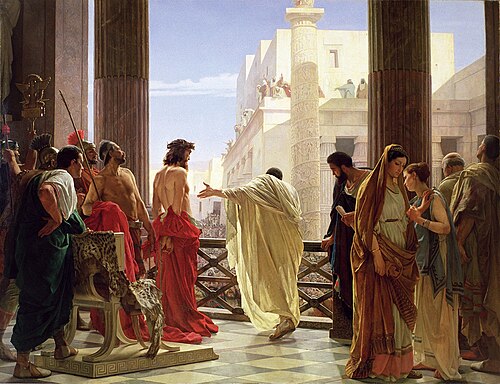
Ecce Homo (“Behold the Man”), Antonio Ciseri’s depiction of Pilate presenting a scourged Jesus to the people of Jerusalem. It took Ciseri twenty years, from 1871 to 1891, to complete the painting (from Wikipedia)

Pilate’s Hands Washing: From Mick Jagger to a Cathedral in Regensburg, Germany

The Rolling Stones lead singer, Mick Jagger, imprinted a passage from the Christian New Testament on the minds of a generation, when in 1968 he first sang “Sympathy For The Devil,” as a personification of Satan:

“And I was ’round when Jesus Christ
Had his moment of doubt and pain
Made (expletive) sure that Pilate
Washed his hands and sealed his fate”

What was the washing of Pilate’s hands all about? In Matthew 27:1-2, the Jewish chief priests and elders judged that Jesus should be put to death, but they sent him to Pontius Pilate, the Roman governor of Judea anyway. Later in Matthew 27:24-26 we read of the aftermath of Pilate’s interview with Jesus:

So when Pilate saw that he was gaining nothing, but rather that a riot was beginning, he took water and washed his hands before the crowd, saying, “I am innocent of this man’s blood; see to it yourselves.” And all the people answered, “His blood be on us and on our children!” Then he released for them Barabbas, and having scourged Jesus, delivered him to be crucified.

All four of the Gospels note that Pilate had a role in Jesus’ crucifixion, but there are some differences in how Pilate is portrayed. What is peculiar about this passage in Matthew is that none of the other three Gospels record the incident of Pilate washing his hands. Neither do the other Gospels tell of the specific response of the people, “His blood be on us and on our children!

Was Matthew putting the blame for Jesus’ crucifixion on the Jews? Or is something else going on here?

On a trip to Europe my wife and I took in 2022, I was stunned to see so much historical evidence of antisemitic sentiment preserved in what was once the very heart of Christendom, central Europe. In Regensburg, Germany stands a great cathedral, where one side looks over the remains of what once was the city’s only Jewish synagogue. Prior to becoming an Anabaptist in the early 16th century, Balthasar Hubmaier, who was then a firebrand medieval priest at that cathedral, preached a pogrom against Regensburg’s Jewish population, leading to the expulsion of Regensburg’s Jews and the destruction of their synagogue. Regensburg’s Jews had been labeled as “Christ-killers,” whereby the blame for Jesus’ death had shifted from Pilate to the Jews, and the label got stuck there.

A memorial to the destroyed old synagogue stands in its place now, overshadowed by the towers of Regensburg’s St. Peter’s Cathedral. On the side of the church is engraved a “Judensau,” an image of several Jews sucking from the teats of a female pig, a disgusting vilification of Judaism.  I do not even want to post an image of this on this blog post! Some 48 towns across Germany have “Judensau” engravings on their Christian churches, dating back to medieval times. Why were church authorities so willing to allow such degrading carvings on their cathedrals?

Some have tried to have these Judensau engravings removed. But I am in a sense grateful that they are still around, as it helped to convince me that antisemitism is real, deeply embedded in the psyche of many, and we should leave reminders of the past around in order to educate younger generations.

Walking around the streets of Regensburg, and other European cities, like Prague and Munich, and seeing the evidence of centuries of antisemitic propaganda advertised by those claiming to be Christians was quite a shock to me. How could so many people call themselves Christians and do such repulsive things towards Jewish people?

That question haunted me as I wandered the streets of Regensburg.

When I reviewed two books on Veracity a few years ago, Augustine and the Jews, by Paula Fredriksen (a convert herself from Roman Catholicism to Judaism), and Future Israel: Why Christian Anti-Judaism Must Be Challenged, by Australian evangelical bible scholar, Barry E. Horner, I felt a lot of discomfort reading about the history of antisemitic acts perpetrated by so-called “Christians.” I got another taste of that discomfort in reading When A Jew Rules the World, by Bible prophecy teacher Joel Richardson, showing that some of my heroes in the early church voiced a kind of anti-Jewish sentiment at times in some sermons. But that visit to Europe two years ago convinced me that the history of antisemitism was worse than I had previously thought.

This blog post goes on multiple rabbit trails, but I want to address several issues:

  • Answering the charge by critics that the New Testament is antisemitic.
  • Thinking about why the Gospel of Matthew portrays Pontius Pilate the way Matthew does.
  • Showing how the Gospels use Greco-Roman compositional devices to frame their narratives.
  • Comparing modern compositional devices with the way first century literature like the Gospels were written.
  • Making the case that a nuanced understanding of biblical inerrancy increases our confidence in the Bible.
  • How Christian “Fan Fiction” has shaped the way we have thought about Pontius Pilate down through the ages.
  • Christians have been both “Bullies” and “Saints” in church history, and why it is important to wrestle with this.

Christians should be able to share the Gospel with our Jewish friends without stepping on mines filled with anti-Jewish prejudice. Journey with me on this exploration of Christian apologetics through the lens of church history!

Bullies and Saints: An Honest Look at the Good and Evil of Christian History, by John Dickson, explores many of the good contributions of Christianity to the world, while also casting a light on a number of the more unsightly episodes of church history, that as a Christian I would rather forget. Celebrating the goodness of the Gospel’s impact on society while simultaneously acknowledging failures of the church along the way is vitally important, in a day when many in Western culture are skeptical about the value of organized Christianity.

Continue reading


Religion of the Apostles, by Stephen De Young, a Multi-Part Review (#2 The Divine Council)

What is the “Divine Council?” Is it some strange heresy…. Or is it something grounded in the worldview of the New Testament and the earliest Christians?

The concept of the “Divine Council” often confuses people. It goes back to a Hebrew word “Elohim,”  used for “god/gods”, occurring over 10,000 times in the Old Testament, found even in very first verse in the Bible, Genesis 1:1.

In the beginning, Elohim created the heavens and the earth.

The word itself is plural, and depending on the context of the verse this could be another name for God, as is the case in Genesis 1:1, or likewise, as in the singular “Yahweh,” or it could refer to a plurality of divine beings, as in a “Divine Council,” among other things.

Scholars have debated what “Elohim” means, but the language of a “Divine Council” is frequently discussed. Some see the “divine council” as something akin to polytheism (the worship of many gods) or henotheism (where there is a high god, with lower gods residing under the high god). But the use of these popular terms do not reflect how the earliest Christians thought of the “Divine Council,” as grounded in the thought of Second Temple Judaism, the next topic covered by Father Stephen De Young, Eastern Orthodox priest and author of The Religion of the Apostles: Orthodox Christianity in the First Century.

Readers unfamiliar with or suspicious of “Divine Council” theology might not be convinced as to what Stephen De Young teaches, but it is worth giving a hearing to the Scriptural evidence, and how it was received by the early church. A common idea in certain streams of historical critical scholarship today says that the “divine council” represents part of the evolutionary development of Israelite religion, beginning with polytheism, which then morphed into henotheism, and then finally arrived at monotheism. I got my first taste of this in my Religion 101 class back in college, and it was a shocker.

Yet when faced with the challenge of these strands of historical criticism, the Divine Council theology of the early church as described in De Young’s The Religion of the Apostles ironically provides the best apologetic for historic orthodox faith: Protestant, Roman Catholic, and Eastern Orthodox alike. As Stephen De Young impacts it, the story of Divine Council theology is profound.


The Religion of the Apostles, by Stephen De Young, shows how the beliefs and practices of the early church connect with the world of Second Temple Judaism, the historical context for Jesus of Nazareth and the New Testament.


The Divine Council as Understood By the Early Church

Stephen De Young engages the biblical evidence for a divine council in the New Testament, a topic that will be readily familiar to readers of the late Michael Heiser’s works (see Veracity review of Heiser’s The Unseen Realm). We encounter such a divine council in the language of the “heavenly host,” like we read about in Revelation 4:1-11 and in the birth narrative of Jesus in Luke 2:13.

Throughout the New Testament, ideas like John’s “heavenly host,” or even Paul’s use of “powers” to be defeated (1 Corinthians 15:24-25) and those in “heaven” who will bow before Jesus (Philippians 2:10-11), indicate that the New Testament writers are not actually strict monotheists, believing that only one “God” even exists. Rather, there is a multiplicity of created divine beings, some in obedience to the uncreated God (Yahweh) and others in rebellion to that God.

In the Book of Revelation, as elsewhere in the Old Testament (like Isaiah 14:13), the “mountain of assembly” is not associated with any one particular mountain in Israel, but it is the place where Yahweh dwells, with his “divine council” surrounding him. In Hebrew, this “mountain of assembly” is known as “har moed,” which is transliterated into Greek in the Book of Revelation as “harmageddon,” known to most English readers as “armageddon.” ‘Saint John’s reference in Revelation 16:16 frames the final siege of God’s holy mountain in terms reminiscent of the first such siege, when the Amalekites assaulted Israel at the foot of Mount Sinai and dared lay “a hand on the throne of Yahweh”’ (Ex. 17:16; De Young, p, 83). This connection is often missed by those fascinated by so-called “End Times” prophecies.

The “Most High God” is another key term associated with the Divine Council, which identifies the uncreated Yahweh as presiding over other created “gods”. Isaiah 14 and Ezekiel 28 both show challenges to Yahweh as the “Most High God.” We see this language echoed in the New Testament where angels and demons refer to God as the “Most High God” (Mark 5:7; Luke 1:32, 35, 76; 8:28; Acts 16:17; De Young, p. 83).

Psalm 82 is cited as a central Old Testament passage showing how Yahweh presides over other divine beings, members of the Divine Council. The terminology of “gods” is used to reference these divine beings that make up these members of the Divine Council. De Young notes that “the final verse of this psalm is sung in the Orthodox Church on Holy Saturday to celebrate the victory of Christ over the dark powers and the beginning of God’s inheritance of all the nations” (De Young, pp. 86ff).

Correcting Misunderstandings About Satan, and the “Three Falls” of the Old Testament

De Young corrects a lot of misunderstanding about the identity of “Satan,” much as Michael Heiser has done, though Heiser and De Young differ on some of the details (De Young, pp. 113ff, and pp. 131ff). Like Heiser, De Young essentially follows the Enochian interpretation of Genesis 6:1-4, which describes a great rebellion among certain members of the Divine Council, leading to the progeny of the Nephilim. 1 Enoch and other documents recovered from the Dead Sea Scrolls identify these “Nephilim” as “giants,” overlapping with the Babylonian tradition of the apkallu. The Goliath of the famous “David and Goliath” story is known as one of these giants, as well as the stories about the “Anakim,” encountered during Israel’s desert wanderings and even into the period of the Israelites settlement in the land of Canaan (De Young, pp. 108ff).

Again, much as to what readers of Michael Heiser will know, there are not one, but rather three separate “falls” that have brought havoc among humans. In addition to Adam’s fall in Genesis 3, we have the “sons of God” having sexual relations with the “daughters of men” in Genesis 6, and finally the Tower of Babel incident in Genesis 10-11 (De Young, pp. 102ff).

It is important to note that while Christians believe that the Apostle Paul articulates the Christian understanding that the root of the human sin problem goes back to Adam (Romans 5), Paul was not the first nor the only Jewish thinker of his day to articulate this. Other authors associated with Second Temple Jewish tradition said pretty much the same thing:

O Adam, what have you done? For though it was you who sinned, the fall was not yours alone, but ours also who are your descendants.  (4 Ezra 7.118).

For, although Adam sinned first and has brought death upon all who were not in his own time, yet each of them has been born from him has prepared for himself the coming torment.  (2 Baruch 54.15).

De Young follows the Eastern Orthodox theological tradition which emphasizes that the sin of Adam is what led to human mortality, and thus enabling human corruption (De Young, p. 103). De Young summarizes that each of the three falls result in three different problematic consequences; namely, first death, secondly sin, and thirdly the dark principalities and powers, respectively (De Young, p. 104). In turn, the New Testament tells of how God dealt with each of these three problems, through the coming of the Messiah Jesus. First, Jesus conquered death (1 Corinthians 15). Secondly, Jesus purified and cleansed us from sin and corruption, applied through baptism (1 Peter 3:20-21). Thirdly, Jesus defeated the dark principalities and powers, the completion of Christ’s work (Acts 1:1; De Young, p. 106).

As a result, Stephen De Young argues that Saint Augustine led the Christian West to depart from this trifold schematic of Christ’s saving work, when he rejected the Enochian interpretation of Genesis 6:1-14 as being about an angelic rebellion. As a result, the Christian West has tended to front load all of humanity’s problems on the sin of Adam at its very root, thereby neglecting what Genesis also teaches in the stories of sons of God having children with the daughters of men, and the story of the Tower of Babel (De Young, p. 121).

De Young dedicates a chapter describing the “saints in glory,” essentially associating the Eastern Orthodox view of salvation, or “theosis,” with the Second Temple Jewish tradition of the Divine Council, arguing that redeemed humanity will be brought to participate in God’s Divine Council. This argument is grounded in the Old Testament examples of Enoch and Elijah:

‘Therefore the notion that Enoch “went to heaven without dying” is misleading, because those who died in the Old Covenant were not seen to “go to heaven” at all. Enoch, rather, was chosen by God to join the divine council as the Prophet Elijah (also known in the Orthodox Church as St. Elias) later would’ (De Young, p. 142)

As other scholars have argued, the traditional interpretation of New Testament believers in Christ as “saints” tends to obfuscate the real meaning of the Greek. Instead, the English “saints” should probably be better translated as “holy ones” (De Young, p. 145). This signifies that believers in Christ will be drawn into fellowship with the Triune God, along with the faithful members of God’s Divine Council.

Becoming Partakers of the Divine Nature: Sanctification in the Early Church

Reading The Religion of the Apostles will help evangelical Protestants who feel squeamish about the Eastern Orthodox view of sanctification, expressed in the language of “theosis.” The theological term “theosis” is often put in quotes as there is just a natural aversion to using the word “god” (in Greek, “theos”) to refer to anything other than Yahweh, the God of the Bible, when it comes to the English language. At one level, this is understandable, but it does not explain why many English-speaking Christians then have little difficulty with believing in “angels.” At its most simple level, a created “god” and an “angel” can in many cases be thought of as the same thing. Nevertheless, the language can easily trip people up, as “theosis,” simply means “divine state.”

In “theosis,” the Christian believer is gradually being made more into becoming one with God, or in union with God, sometimes called the process of “deification.” Before anyone freaks out about the terminology put in quotes as “deification,” the idea is drawn from 2 Peter 1:4, whereby Peter teaches that believers “may become partakers of the divine nature.”

But once one sees in the New Testament where “son/sons of God” language is associated with the “holy ones” (or “saints”), then it becomes easier to notice that God’s desire to bring humanity into fellowship within the Divine Council flows out of this strand of Second Temple Jewish thought. While this understanding of “deification” sounds alarming to at least some Protestants, it is not so controversial once someone carefully examines the Second Temple Judaic sources, which provides the ideas that feed into our New Testament. It is important to note that this has nothing to do with the Mormon theological fantasy invented by Joseph Smith in the 19th century of man somehow becoming a “god” to rule their own planet or universe, nor is it about ideas of “deification” found in New Age theology.

A passage like John 1:12-13 illustrates what this really is:

“But to all who did receive him, who believed in his name, he gave the right to become children of God, who were born, not of blood nor of the will of the flesh nor of the will of man, but of God” (ESV).

While the gender inclusive impulse in many contemporary Bible translations are well intended to show how “sons of God” should be understood as “children of God,” this can tend to obscure the connection between the “son of God” language of the New Testament and Divine Council theology found in the Old Testament. It would help to know that one of the primary differences between the understanding Jesus as “the” Son of God, versus Christian believers as “sons of God,” whereby Christians become partakers of the divine nature (2 Peter 1:4), is that “the” son of God, known through the incarnation of Jesus in his divinity is not a creature, whereas Christian believers are creatures, a distinction of utmost importance in the understanding of “theosis” which most Protestant critics typically miss.

In evangelical Protestant theology, the doctrine of the Christian believer’s union with Christ comes the closest to the Eastern Orthodox view of “theosis.” Stephen De Young effectively shows that this understanding of sanctification has its roots in the ancient Jewish tradition. Interestingly, even some Lutheran theologians acknowledge that Martin Luther’s ideas about sanctification mesh in well with a classic Eastern Orthodox understanding of “theosis,” though some differences between the Lutheran Protestant and Eastern Orthodox approaches to sanctification have not been fully resolved. In other words, Protestant and Eastern Orthodox understandings of sanctification are not as far apart from one another as commonly thought, but in theological discourse today some of those remaining differences are still a bridge too far to cross, at least among some.

As Saint Athanasius, the most vocal proponent of Nicene Trinitarian orthodoxy of the 4th century, put it: “For the Son of God became man so that we might become God,” in his classic work, On The Incarnation (chapter 54, sentence 3). Stripped out of its Second Temple Jewish and early church context, such a statement might come across as being Mormon in some way. Yet properly placed within its historical context, Athanasius’ statement is a good summarization of how the early apostolic leaders of the Christian movement understood sanctification, something that every Christian, whether they be evangelical Protestant, Roman Catholic, or Eastern Orthodox, would find worthy and Scripturally accurate to embrace.

The importance of this evidence from the early church, drawing on certain strands of Second Temple Judaism, can not be underemphasized. Many skeptics assume that Christianity is based on a modified form of Judaism, which itself was derived from an ancient form of pagan polytheism. In other words, the concept of a single “God” actually had its roots in a world of multiple gods, not one “God.” As noted earlier, much of modern historical criticism since the 19th century has argued that the story of the Bible is evolutionary regarding the doctrine of the divine, beginning with a kind of polytheism (many gods, all of equal status), which morphs into henotheism (one god, ruling over other gods), which then morphs into monotheism, which then in the centuries after the New Testament is transformed into trinitarianism. Much of this 19th century narrative assumes that the Old Testament Jews simply borrowed concepts of god/gods from their pagan neighbors, only to channel that theology through the sieve of Persian Zoroastrian monotheism to produce a unique brand of Jewish monotheism. Then the New Testament borrows a variety of pagan concepts to produce the doctrine of the Trinity.

In contrast, Stephen De Young’s argument is that we have Yahweh, the uncreated God, who created these other divine beings in the Divine Council, and this framework remains consistent throughout the whole Old Testament, from start to finish, and into the New Testament. In the previous blog post in this series, De Young’s argument suggests a kind of progressive revelation, an unfolding of our knowledge of God eventually leads to the disclosure of One God in Three Persons, which emerges in the early centuries of the church. The roots of the Bible are drawn from the soil of Ancient Near East Israel through Second Temple Judaism, and not some borrowing of pagan mythology. De Young’s narrative regarding the Divine Council and the doctrine of the Trinity stands in stark contrast with the evolutionary narrative which grew out of the liberal theology and historical criticism of the 19th century.

Contrary to what a number of critics today say, the theology of the Divine Council is not some invention of modern historical criticism, a Mormon theological fantasy, or even the supposed novel evangelical teaching of the late Michael Heiser. Rather the theology of the Divine Council is rooted in the religion of the apostles of the first century.

The next installment of this review of Stephen De Young’s The Religion of the Apostles will focus on the doctrine of the atonement
